You own a home in Italy and want to rent it to guests for short stays. Good news: the rules are clear once you see them in order. This checklist covers what every owner needs in 2026, even if you live abroad.
The short version
- Get a CIN (national ID code), show it outside the building and in every listing, and fit gas and carbon monoxide detectors plus fire extinguishers.
- Register every guest with the State Police (Alloggiati Web) within 24 hours, after checking their ID in person.
- Collect the tourist tax where your town charges it, send ISTAT data to your region, and declare the income in Italy.
1. CIN: the national identification code
Since 1 January 2025 every home rented for short or tourist stays in Italy needs a CIN (Codice Identificativo Nazionale). The legal basis is article 13-ter of Decree-Law 145/2023.
How to get it:
- Log in to the Ministry of Tourism's Banca Dati delle Strutture Ricettive (BDSR) at bdsr.ministeroturismo.gov.it. You need an Italian digital identity (SPID or CIE).
- If your region already gave you a regional code (for example CIR, CITRA, CIS or IUN), the BDSR links it to your CIN.
- Owners without SPID or CIE often ask an Italian accountant or property manager to help.
Where to show it:
- Outside the building, on a sign or plate.
- In every listing, on Airbnb, Booking.com, your own website and anywhere else.
The Ministry's own words: CIN codes "must be displayed outside the buildings and shown in listings".
2. Safety devices required with the CIN
The same law requires, in every unit rented for short or tourist stays:
- working detectors for combustible gas and carbon monoxide;
- portable fire extinguishers: at least one per floor and one every 200 m², placed where guests can see and reach them.
If the home has no gas appliances and no risk of carbon monoxide, the detectors are not required. The law does not mention smoke detectors. They are a good idea, but they are not part of the CIN rules.
Missing devices can cost €600 to €6,000 per violation.
3. Guest registration: Alloggiati Web
Italian law (art. 109 of the public security code, TULPS) says you must register every guest with the Polizia di Stato through the Alloggiati Web portal:
- within 24 hours of arrival;
- within 6 hours if the stay is shorter than 24 hours.
In-person ID check: the current status. In November 2024 the Interior Ministry said hosts must check guests' identity face to face. A regional court (TAR Lazio, decision 10210/2025) set that guidance aside in May 2025. Then, on 21 November 2025, the Council of State (decision 9101/2025) overturned the TAR. Uploading documents online and sending an automatic door code is not enough.
What this means for you:
- A keybox with remote-only identification does not comply. Someone must see the guest and compare them with their ID.
- The Council of State said a real-time video link that checks the guest against their ID is not ruled out. No official procedure describes it yet, so check with your local police headquarters (Questura).
- Some cities also limit keyboxes on the street.
Check your town's rules.
4. Tourist tax (imposta di soggiorno)
Many Italian towns charge a tourist tax per guest per night. Each town sets its own rate, season, maximum nights and exemptions. In our town guides (in Italian) you can see how different they are:
- Alghero: €2.00, all year, max 7 nights.
- Positano: €2.50, April to October.
- Bardolino: €2.50, max 20 nights.
As the host you usually:
- register on the town's tourist tax portal;
- collect the tax from guests and give them a receipt;
- report and pay the town monthly, quarterly or by season;
- file the annual tourist tax return with the Agenzia delle Entrate by 30 June of the following year.
Some platforms collect the tax for you in some towns. Check in your host account and confirm with the town hall.
5. ISTAT statistics
Your region collects guest numbers for ISTAT, the national statistics office. Each region has its own portal: for example Ross1000 in Lombardy, Veneto, Piedmont, Liguria and Sardinia, Sinfonia in Campania, DMS/SPOT in Apulia. Check your region's tourism website.
6. Income tax: be careful
This part depends on your personal situation.
Keep it simple and get advice.
- Rental income from an Italian property is generally taxed in Italy, even if you live abroad. Check the tax treaty between Italy and your country.
- You can usually choose the cedolare secca, a flat tax: 21% on one property of your choice, 26% on the others.
- If a platform takes part in the payment, it withholds 21% as an advance on your tax.
- From 2026, renting three or more homes for short stays is presumed to be a business. You then need a VAT number and more.
- You need an Italian tax code (codice fiscale) and usually an Italian tax return.
Talk to an Italian commercialista before your first season.
Your printable checklist
- CIN requested on the BDSR
- CIN plate outside and code in every listing
- Gas and CO detectors (if needed) and fire extinguishers
- Alloggiati Web account active
- A plan for in-person ID checks
- Registered on the town's tourist tax portal
- Registered on the regional ISTAT portal
- Accountant contacted for income tax
Plan your 2027 season
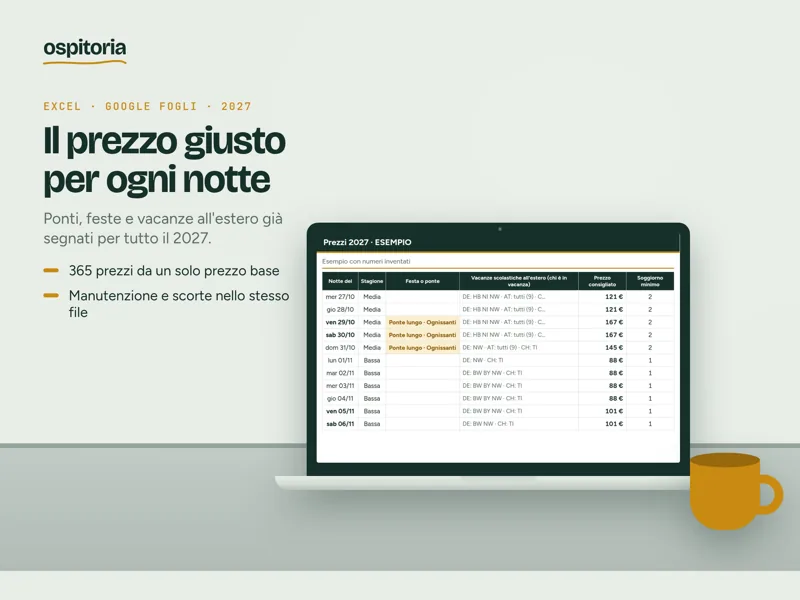
Once the paperwork is done, plan prices and upkeep for the whole year. Our planner comes in English, Italian and German.
The tool for the job
Planner Annuale Host 2027
Host Planner 2027: an Excel planner in English (Italian and German included). Nightly prices for all 365 nights with Italian holidays and German, Austrian and Swiss school holidays, a monthly summary, 25 maintenance checks and a supplies list. No subscription.
19,90 € one-off payment
See the tool →Want guests to find Wi-Fi, check-out times and house rules without messaging you? The Welcome Book is an editable guest book in 5 languages: English, Italian, German, French and Spanish.
Our free obligations checklist is in Italian, handy to share with your Italian co-host or accountant.
Free Host obligations checklist 2026 (Italy) CIN, guest registration, tourist tax and safety, in one PDF in Italian.
Get it by email →FAQ
Do I need a CIN if I rent only a few weeks a year?
Yes.
The CIN is required for any home rented for short or tourist stays, however often.
Can guests check in with a keybox?
A keybox is fine for the keys, but not for the ID check. After the Council of State decision of November 2025, someone must identify guests in person.
Do I have to collect the tourist tax?
Only if your town charges it.
If it does, the host usually collects it and pays it to the town.
Last checked: 08/10/2026. Sources: Ministry of Tourism, BDSR and CIN notice; Polizia di Stato, Alloggiati Web; Agenzia delle Entrate, short-term rentals guide; Ministry of Economy and Finance, tourist tax return. Rules change: always check with the official source. Not tax or legal advice.
This is general information, not tax or legal advice. Rules and rates change: always check the official sources of the municipality.